Showing posts with label Afghan National Army. Show all posts

Wednesday, September 15, 2010

An afternoon with Afghan heroes

Today, I had a visible reminder that while the wounded U.S. and coalition forces are the more visible casualties of the fight in Afghanistan, there are others who are fighting for and dying for this country – the Afghans themselves. On our way to visit wounded Afghan soldiers at the National Military Hospital in Kabul, our convoy was halted by a funeral procession. I looked out the window and saw a huge crowd of people – mostly in military uniform, so I knew it was a funeral for a fallen Afghan National Army soldier.

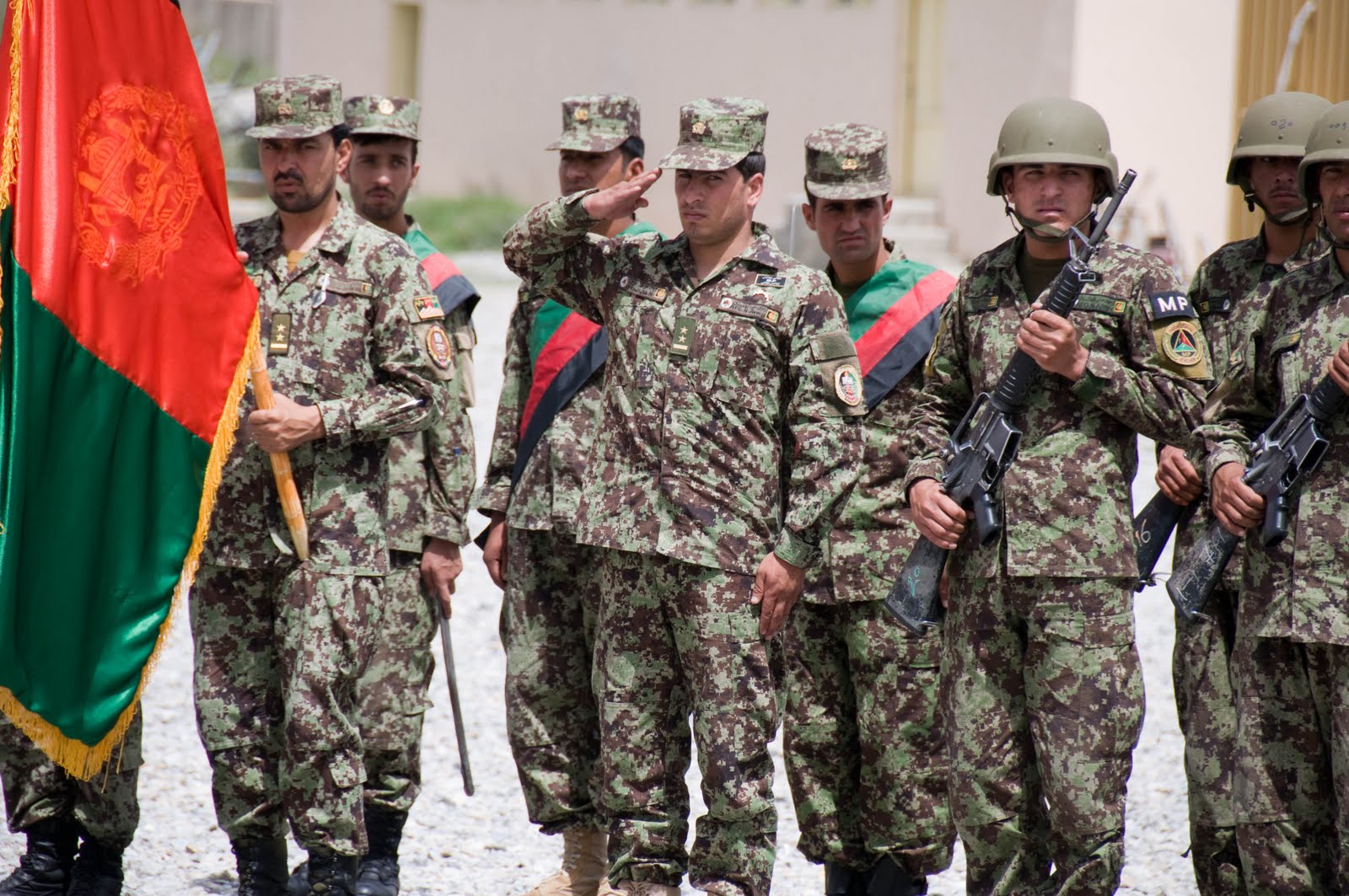
Although little publicized, especially to the American public, the Afghans are joining their armed forces - the Afghan National Army and Afghan Uniform Police - in droves. In a little less than a year, the army has grown almost 40,000 soldiers and the police by more than 20,000. Motivated by the need for a peaceful and stable country, these men and women are risking their lives to protect their country, fight corruption, drug lords and the Taliban who are doing their best to pull this country down.

Wounded soldiers are stabilized at the nearest regional hospital, located in Kandahar, Herat, Mazar-i-Sharif and Gardez, and then sent to the national hospital, if necessary. On our trip to NMH, we visited with about 15 soldiers who had been injured in various IED attacks and firefights with Taliban. In addition to Lt. Gen. Caldwell, commander NATO Training Mission – Afghanistan and Command Sgt. Maj. Beam, with us were Afghan Gen. Sher Mohammad Karimi, ANA Chief of Staff and Command Sgt. Maj. of the Afghan National Army Roshan Safi, who I later learned has been a frequent visitor to the hospital.

We were there to present Army achievement medals to the soldiers, recognize them for their bravery, and thank them for their sacrifice. Many had lost legs, some were severely burned or disfigured, and in one disturbing case, the patient was emaciated, after spending two months in a trauma-induced coma. It was heartrending to see the victims of this insurgency up close and personal, and I had tears in my eyes to see them laying on their hospital beds. Even though they weren’t my fellow American servicemembers, they were soldiers fighting the same enemy and I couldn’t help but feel a connection to them.
The Americans, and our Coalition partners - British, Canadians, Italians, French, and Spanish – have all recently lost servicemembers, but they are not the only countries with people willing to fight and lose. The country we are here to help is filled with those who are also willing to pay the ultimate sacrifice. They too are fighting for independence, for peace, for freedom.

Let us never forget.

Saturday, September 11, 2010

One step closer ...

Last month, I covered a ceremony officially opening a new infantry school in Kabul for the Afghan National Army. The move is a big step for the ANA as they work toward professionalizing their force. NATO Training Mission – Afghanistan and the Afghan government have spent much of the last 10 months building a force large enough to protect the country, with much of the focus on recruiting and end-strength goals. Now that the ANA has met their goal of 134,000 soldiers, two months early I might mention, they are turning their attention to building the necessary specialized skills – medical, infantry, communications, artillery, etc. – that make up a military.

Previously, infantry tactics, including reconnaissance and heavy weapons systems courses were taught under the Advanced Combat Training Brigade at the Kabul Military Training Center; now the ACT brigade is in the process of separating all advanced branch training, including artillery, maintenance, logistics, signal and engineer, into separate schools to enhance training.

The new school will allow the ANA to develop entry-level soldiers, NCOs and officers by providing more space for training, time and attention on infantry-specific skills. It will do much to boost the ability of the Afghan infantry soldiers and, perhaps even more importantly, will be run and taught by the Afghan army with support from the British. Slowly but surely U.S. and NATO forces are handing more and more responsibility over to the Afghans.

The first class of 211 students to go through the new school began training July 31, 2010. If courses run at full capacity, the new school will be able to accommodate up to 2,000 students at one time, or 14,000 infantrymen per year. This is a historic time for the Afghan National Security Forces. It seems every day there are more and more signs of progress and milestones reached and even though I didn’t have any direct impact on their success, I can’t help but feel proud of all that they’ve achieved.

Thursday, July 29, 2010

Afghan women don't struggle alone


Afghan women face many challenges; cultural, societal and religious views create barriers that often prevent them from entering the work force, attending school or joining their military. The minority of women who do confront the status quo are faced with attitudes about women’s roles in society, discrimination and sexual harassment.

Currently there are 301 women serving in the Afghan National Army and just fewer than 1,000 in the Afghan National Police. While the ANA is on schedule to meet its overall recruiting goals of 134,000 by October 2010, the Ministry of Defense (in charge of the army) is struggling to fill the mandate of having women make up 10 percent of the army’s end strength.

A few weeks ago, I was invited to attend a women’s forum that was going to be hosted by a group of NATO Training Mission – Afghanistan mentors. The purpose was to try to improve conditions for women in the ANA by giving them an opportunity to meet with other women in the military and learn from their experiences. I haven’t seen a lot of female Afghan soldiers, so I was very interested in going; Rachel, one of my female co-workers, and I joined a group of U.S. military women on Sunday, along with another civilian journalist, Gayle Lemmon for the forum.

When we arrived, Afghan Gen. Khatool Mohammadzai was speaking to the crowd of about 60 women, both civilian and military. The women all had lots of stories of being passed over for promotion, or in the cases of the civilian women, not being allowed to join the military because their families didn’t approve. One woman in particular stood out to me; she stood up to speak, saying she had been working for the army for 20 years but in all that time, had never received a promotion or pay raise. With tears in her eyes and her voice cracking, she told that every time asked for a promotion, the men would ask for a kiss or say she had to spend the night with them.
During a break, I had a chance to interview General Mohammadzai, who has served in the ANA for 30 years, as a parachute instructor to education director at the ministry.

She told me that there are many hardships facing Afghan women today; families won’t let women join (they have to attend a two-week training which requires them to stay overnight at the training center, away from home) or people will say bad things about those who do join. I asked her if there were any plans to modify the training program so that women can attend but also leave at night to take care of their families – currently the police training allows women to leave at the end of each day. Mohammadzai didn’t directly answer the question, but rather told me that when she joined, people talked about her but she didn’t care. She said education and training was necessary for females and males and that they need to learn the same things.

“I didn’t receive this position the easy way, I work very hard. I’m very proud I’m alive right now to see women in the uniform,” Mohammadzai said, after telling me that during her early years in the parachute unit, she broke her hand and leg and lost teeth.

I interpreted her answer to mean no, training most definitely would not be adjusted and that women were going to have to continue to fight for their freedoms and rights. In a way I could understand her position – by giving in to pressure to accommodate the training schedule, it would somehow undermine the struggle and lessen the accomplishments a few women have fought so hard for. If women are demanding equal rights and freedoms, taking the easier path is almost like cheating.


“We started from zero, but we’re improving and creating a good facility for women. It has improved the last eight years,” she said. “Other countries have men and women in the military; Afghanistan should be the same.”

One of the American speakers, Marine Col. Sheila Scanlon sought to acknowledge the struggles they face, while praising the women for their courage and perseverance.

“You make many sacrifices just doing what you need to do for your families but when you serve your country, you have to make more sacrifices,” Scanlon said. “Even in the U.S., men say women do not belong in the Marines, but it hasn’t stopped us; it has made us stronger.”

Several of the American women who attended the forum had been influenced in some way by a woman challenging the standards. Some had mothers who joined the Marines or male-dominated career fields at a time when women were still new to the military, or like Colonel Scanlon, were paving their own way.
Air Force Capt. Stacy Eskridge, one of the forum organizers, has taken up the ANA women’s cause. She is also working to get women the use of a gym, daycare services, and computer classes; she has also helped start a women’s driving course that will begin after Ramadan.

While we ate lunch I got to chat with her about why she was helping; she was very passionate about helping these women, and took their advancement personally. Stacy told me that in many cases, even once a woman is able to join the army, the men in their units won’t let them do work; they are often made to make tea or clean offices.

“They didn’t join to serve chai, they joined to be in the military,” she said. “They don’t get to see very many females in the military, just each other, which is why is so important to have events like this. The same battle our mothers had is what they’re dealing with here.”

Thursday, July 22, 2010

In the palm of your hands


Abandoned as a baby, 12-year-old Haidar has never buttoned a shirt, held a pencil, combed his hair or played with a toy. Born with a twisted knot of bone, joints and fingers instead of normal hands, Haidar never been able to properly care for himself; he has only been able to use his wrists and forearms to pick up objects and manipulate his environment.

Haidar was brought to the National Military Hospital in Kabul in the hopes that the Afghan army doctors there would be able to help his situation, but they lacked the expertise to operate. When they learned an American reconstructive hand surgeon would be soon arrive as part of the new medical embedded training team rotation, the ANA doctors admitted Haidar.

One month later, U.S. Navy Capt. Jerone Landstrom, a surgeon specializing in hand and microsurgery, arrived and Haidar had his left hand operated on, giving him, for the first time, the ability to pick up objects. While Haidar’s hand will never look like a normal hand, it is functional.

Our office heard about the operation, and thought that it would make a great story. We cover anything related to training, but so often that focus is limited to developing the Afghan National Security Forces, even though our mission scope is much broader. We were invited to come out to the hospital to meet with Dr. Landstrom and the Afghan doctors who assisted him during the operation.

Working with Dr. Ab Ghafoor-Ateef, the Afghan orthopedic resident who admitted Haidar, Dr. Landstrom, who has been practicing for 27 years, taught the surgical staff the essentials for performing complex reconstructions. This type of surgery hadn’t been performed at the 400-bed military hospital before; Dr. (Gen.) Bahaudin, head of the surgery department, told us that the hospital typically treats major trauma injuries resulting from improvised explosive device attacks or vehicle accidents.

For a hospital used to dealing with trauma patients, Haidar’s case is a success story for both the Afghan physicians and U.S. mentors, especially as they work together to improve the supply and logistics systems and handle the nursing shortage. Based on their current tash-kil, or manning document, they don’t have enough nurses to fully support the ICU ward which international standards suggest having one nurse per bed, and there aren’t enough nurses to provide long-term care. The staff often relies on a patient’s family member to help feed and bathe patients.
More than anything, having the U.S. embedded medical team has given the Afghan physicians a chance to improve their technical skill base and improve the quality of care they’re able to offer patients. In addition to working directly with Dr. (Gen.) Bahaudin, who is responsible for nine departments including neurosurgery, urology and ear, nose and throat, Dr. Landstrom mentors the ICU staff as well as the plastic and orthopedics departments.

The center of the Afghan National Army healthcare system, the NMH mainly treats soldiers and their families, and Afghan National Police patients with injuries too severe for their own hospital to treat. So when I asked how Haidar was able to receive treatment, they told me a relative brought him, but no one seemed to know who he was or what relation he was to the boy. I’m guessing the relation, if he even exists, is a very distant one, but that just further demonstrates the Afghan capacity for compassion.

In terms of sterility, cleanliness, efficiency and capability, NMH is definitely not a typical Western hospital, but they are doing the best they can with what they have. Dr. Landstrom told me that the staff has far exceeded his expectations; he has worked at hospitals in other developing countries like the Philippines and in comparison the NMH has much higher standards.

Landstrom told us that the staff has far exceeded his expectations and have higher standards than some of the hospitals he’s worked at in other developing countries like the Philippines. Landstrom’s goal is to pass along some of his expertise to the surgeons during his year-long tour; already they are learning and taking over – Dr. Ghafoor assisted in Haidar’s first surgery and will be the lead surgeon on the second operation. I hope Haidar’s second operation is as successful as the first; I couldn’t image how difficult his life must have up this point and a simple thing like being able to pick something up can change a life.

Thursday, June 17, 2010

Building a ring of steel

Kabul is a sprawling city with an estimated population of four million people. Its streets are crowded with thousands of cars, a vast majority of them white Toyotas typically on the warning alert watch.

Although Kabul is considered relatively safe, insurgents still manage to surprise the city with random attacks, most recently on a U.S. convoy that killed five Americans and one Canadian soldier. To protect the city, its residents and the large number of UN and foreign organizations located here, the Afghan National Army and Afghan National Police are creating secure perimeters around the city.

Part of a new initiative to secure Kabul from the inside out, the layers of security include five Army forward operating bases, a series of city gates, and a string of 25ANP checkpoints known as the ring of steel.

My co-worker and I recently visited some these checkpoints with some of the engineers from Regional Command – Central who have been helping the ANP organize and build up the security stops. Before the engineers got involved earlier this year, the ANP had hundreds of checkpoints dotted randomly around the city, but they weren’t as effective as they needed to be. Under RC-C guidance, the ANP has consolidated the scattered checkpoints into a tight perimeter and built them up to be easily recognized.

Designed to cover every point of entry, by both foot and vehicle traffic, into the city center, the ring of steel is considered to be a low-cost, high-payoff project for the Combined Security Transition Command – Afghanistan (CSTC-A) who has helped fund and equip the checkpoints. The checkpoints have been outfitted with barriers, booths, traffic control tools and big blue signs. The plan was to make it a comfortable place for the police to serve and to make the stops visible, legitimate and hard to duplicate, in order to prevent unofficial stops.

While the engineers said that the security plan for Kabul was still relatively immature, the ANP have made huge strides, and security is better than it was even just two months ago. During our tour of the checkpoints, we stopped at the busiest one with the most traffic, one located at the end of a footbridge leading into the city center and one in a residential neighborhood. We got the opportunity to talk to some of the residents, including Mohammad Maroof, a taxi driver who has been a Kabul resident for 40 years. He said that the locals feel more comfortable with the police presence there.

“We all sleep comfortable at night, even when our doors are open because the ANP is here and security is pretty good,” he said. “We feel more secure here and the shop keepers are open late at night. Our children are safe.”

While they have a ways to go, as far as training and equipment, learning how to man the checkpoints and earn the trust of the citizens, with the help of NTM-A, the ANP and Army have a successful start.

Wednesday, May 26, 2010

I pledge allegiance to ...


At the Turkish-run Gazi Training Center, 400 Afghan National Army recruits stood in the hot sun waiting to swear their commitment to the service of their country. Half-way through their eight week basic training course, the trainees were participating in an oath-swearing ceremony, promising to protect and defend Afghanistan.

The ceremony reminded me of an event in my own Air Force basic military training almost seven years ago; since then, basic training has been extended and changed to match the skills Airmen enlisting today would need, but back then, we had something called a coin ceremony. In our fifth week of training, known as “warrior week” trainees are sent out for a week-long field exercise. At the conclusion, each of us was presented with an Airman’s coin, symbolizing our transition from “trainee” to “Airman.” Patriotic music played in the background and our drill instructors who had yelled at us, pushed us and motivated us (sometimes out of fear) congratulated us on our hard work and achievements. I know for many, including myself, it was a proud and moving moment. It was also the proverbial light at the end of the tunnel; it meant we had made it through BMT and provided we didn’t royally screw up the rest of the time, we would be graduating.

The ANA ceremony, while a lot different, was still a very cool experience – I hope the trainees felt the same motivation my fellow trainees and I felt when we received our coins. The patriotic music playing in the background, the marching and presence of leadership was all very similar; but they took it a step further. Each trainee placed one hand on a table and one on the trainee next to him and swore that he would defend and protect his country. They were sharp and crisp in their movements, and the oath was said in unison.

For four-week trainees, I was very impressed. Their marching was better than that of some of the eight-week graduating classes I’ve seen.The Gazi Training Center has been considered a success since it began operating in February 2010. With a 27 Turkish instructors and 28 Afghan instructors, the teacher to student ratio is only 1-to-8, much lower than the 1-to-50 (and often, more) ratio at the much larger Kabul Military Training Center nearby. The additional trainers allow instructors more hands on time with students. The first graduating class - more than 600 trainees - had a 38 percent literacy rate; the average graduating class at KMTC may have about 18 percent and literacy training has been dropped from the course to allow for more time on infantry-essential skills such as marksmanship.

The Turkish have been so successful in their training effort that after this class graduates in June, they’re going to switch from running a basic training program to teaching a non-commissioned officer course. I have no doubt they’ll be churning out skilled, literate NCO’s to help lead the Afghan Army in no time at all.

Wednesday, April 21, 2010

Getting the party started right

Every culture celebrates a special occasion in its own unique way; in the U.S. we typically have cake, balloons and music. In Afghanistan, they sacrifice a cow.

Our office covered the cornerstone laying ceremony for the new Afghan Defense University headquarters at Quarga in early April, where, after the typical speeches from various Afghan National Army leaders, a few ceremonial bricks were placed at the construction site ... and then the Afghans blessed the land by sacrificing a cow.

When I arrived at the construction site, I started taking pictures and talking to people, looking for a few good interviews for the story. One of my co-workers handed me a program and said, ‘Did you see their going to kill a cow’? Up on hill, overlooking the construction site, was a cow and two handlers. I wasn’t sure if really believed they would kill the cow or not, but indeed, they did. I had a front row seat; turns out I’m not that squeamish. I found out later they distributed the meat to families in need; nearby there was a refugee camp so hopefully some was brought there.
The ADU will be home of the National Military Academy of Afghanistan, a four-year military university modeled after the U.S. Military Academy at West Point, a dining facility, library, clinic, post exchange and several additional military schools. Over the next three years, these facilities will be built on 1,500 acres of land that was once used as Ahmad Shah Massoud’s stronghold. Known as the Lion of Panjshir, Massoud is an Afghan national hero who fought against the Soviets during the Russian occupations and then the Taliban; he was assassinated, Sept. 9, 2001.

Although it will take a few years for the ADU to be finished and all the schools moved there, it’s a huge symbol of courage, strength and hope for the people of Afghanistan. They are consolidating their Afghan National Army training facilities in one central location, and this place will hopefully become synonymous with honor, security, educated and ultimately, the future of the country.

Tuesday, March 23, 2010

A presidential duty

Imagine the president of the United States coming to your college graduation; having him (or her!) be the guest speaker and personally handing you your crisp diploma. How exciting, how cool would that be? And imagine how you would probably always remember something like that. A few days ago I attended the graduation ceremony for the National Military Academy of Afghanistan Class of 2010, where Afghan President Hamid Karzai spoke and then stayed to personally present each of the 212 graduates with their diploma and ceremonial sword. Talk about making someone’s day!

I was thoroughly impressed. The guest speaker at my college graduation was Eliot Spitzer, then the New York state attorney general, who became the NY governor several years later, quickly followed by his resignation over his involvement in a high-priced prostitution ring. Ooops.

Since Karzai was attending, security was extremely tight for the graduation and our gear had to be examined and all of us patted down. Once inside the gymnasium, our movements were restricted to certain areas. Not being one to listen, I moved around under the glaring eyes of the presidential secret service. “Madam, you can’t go here.” And “Miss, you can’t go there.” Oh, ok, sorry, sorry, I nodded. All the media were penned up in one section and I was told that they would let two or three come to the front at a time. Finally, I just went to the front of the room where the U.S. military guests were seated and parked myself up there. There was no way I was getting stuck in the back. So I was lucky enough to get some great views, and shots of Lt. Gen. Caldwell and President Karzai speaking, and I was able to get an earpiece that we use to hear the interpreter give the English translation.

Although graduations seem really common around here, this one was particularly important. The academy is modeled after the U.S. Military Academy at West Point and provides graduates with a four year degree in civil engineering, computer science, management, law or English language. It also allows the graduates to become commissioned officers in the Afghan National Army or the Afghan National Army Air Corp. The Class of 2010 was only the second class to graduate from the academy; the first graduated last year. And the audience was packed with undergrad cadets, who were very enthusiastic and supportive of their senior counterparts. So while the program is relatively new, it’s produced and is continuing to produce, qualified, educated, literate leaders for Afghanistan.

Oh, and did I mention, after President Karzai finished handing out diplomas, he took the time to greet several of the U.S. military officials attending the ceremony … including yours truly! Ok, now that made MY day.

Saturday, March 13, 2010

A hero’s heart

I’m the type of person who finds it hard to sit back and watch, especially when it comes to showing someone how to do something. My friend Nestor can attest to that - when I was training him on design and layout at his first public affairs position, I was not the most patient of instructors, often pushing him aside so I can finish pages faster. I'm sort of like the parent who completely takes over their kid’s science project, because, obviously, I can make the volcano bigger, better, cooler.
So I understood completely when Dr. Lorn Heyne, an Air Force colonel in charge of a medical advisory team at the Afghan National Army hospital at Camp Hero, Kandahar, told me that his team was trying very hard to step back and let the Afghan medical staff take charge.

“We, as American’s, have an inherent desire to do, we want to get in there but we made a conscious decision and effort to have them do it so they could arrive at the right decision and course of action themselves,” he told me.

For the last eight months or so, Colonel Heyne and his embedded medical team has been mentoring the ANA doctors and nurses at the military hospital, with great success. The hospital mortality rate has declined 20 percent and they’ve doubled the number of doctors on staff; no easy feat in itself when staffing is one of the biggest challenges the hospital faces. Kandahar is a dangerous area, and professionally-educated people aren’t exactly jumping at the bit to work there.
But despite the obstacles – lack of qualified personnel, supply issues, inexperienced staff and security concerns, the hospital and its staff are doing amazing things. They’ve created a medical library, host a weekly women and children’s clinic, and have an emergency system in place including inbound patient communication systems and ambulances, and an intensive care ward, which they beefed up in preparation for Operation Moshatrak – their ICU is a source of pride for the hospital staff. On a visit to the hospital, the ANA deputy surgeon general said it was the best ICU capability he’s seen out of the other military hospitals.

There are three other regional ANA hospitals, and the 400-bed national military hospital here in Kabul, all doing their best to create a nationwide military medical system. It’s hard to see the big picture in Afghanistan sometimes, about what we’re doing here and even harder to see the results of all the time, money and energy we’re putting into this country. But when I toured the Kandahar hospital and saw the dedication of the staff, the pride in what they’ve been able to accomplish and where they hope to go, it definitely fills in the gaps. Two years ago, a suicide bomber attacked Kandahar City, killing 100 people and injuring 67; 47 of those wounded were taken to the Kandahar regional military hospital. For two days, they worked non-stop and in the end, they managed to save all but one patient.

The list of accomplishments is remarkable, but what was most impressive to me was the professionalism of the Afghan medical staff. These are people who were either left Afghanistan during the fighting to continue their education or practicing medicine, and have come back to care for their people. Col. Aelaj Basir, the hospital commander, is determined to follow his physician’s code of ethics and insists on treating everyone – civilians, Afghan National Army and Afghan National Police, who are infamous for their rivalry, and even Taliban patients – with equal care. He believes that all patients are human beings and deserve the same care and treatment.

And it is that belief more than anything that will help the Afghan people to have faith and trust in their government and leaders – I’m sure the Taliban isn’t offering their IED or bomb victims medical care.