So this is a deployment related entry, but not about the training and development issues I typically write about. Yesterday, while walking to the Ministry of Defense, which oversees the Afghan National Army, I had an interesting conversation with one of our interpreters (who I will just refer to as A for his privacy) about one, yes, one of his new girlfriends. He has four, which according to him, is too many, so he’s trying to pare it down to three. Much more manageable.
It’s fascinating to learn about other cultures and the Afghan’s I work with are always more than willing to answer our questions in exchange for their own. We’ve talked about everything from dating rituals to holiday and family traditions. Afghans are known for many things, among them their generosity and hospitality, and their family-oriented culture. Arranged marriages are very common, as is the custom of marrying cousins but as times change, so do relationship practices. Many of our Afghans have talked about the new, unwritten (and confusing) rules of meeting and dating women in Kabul today. More and more they are seeking out their own partners as opposed to getting to know a girl after marriage or marrying a family member with whom interaction is permissible, until the “couple” is older, and a chaperone is required.
Several of our interpreters have girlfriends whom they secretly date, however, I was shocked to hear that A not only had four, but to hear some of his escapades … and the way he’s using technology such as blue tooth to exchange phone numbers. Girlfriend number four was picked up at a wedding; given that he couldn’t very well cross the room and strike up a conversation, A told me that they “talked” with their eyes. Then he held up his phone for her to see and casually walked by, whispering out of the corner of his mouth for her to turn her blue tooth on. Phone numbers were exchanged and now they are free to speak to each other whenever they choose. And here I though dating in American was complicated.
And of course, if things don’t work out, A can always use one of his creative break-up methods. My personal favorite was the heart-surgery story. Rather than ending things with a girl, A prefers to tell her that he has to go to Pakistan for a risky heart operation, during which he has a 98 percent chance of dying. Now, if the girl happens to call your phone to check up on you and your mom answers the phone, as A’s did, this could backfire, but all in all, not a bad plan.
I believe, ladies, that there is a lesson here and that would be to be careful who you date and perhaps not be too trusting … especially if your man has to undergo an extremely dicey operation. Not all men are bad but it seems there definitely shady characters in any culture.
Monday, August 9, 2010


Thursday, July 29, 2010
Afghan women don't struggle alone

Afghan women face many challenges; cultural, societal and religious views create barriers that often prevent them from entering the work force, attending school or joining their military. The minority of women who do confront the status quo are faced with attitudes about women’s roles in society, discrimination and sexual harassment.
Currently there are 301 women serving in the Afghan National Army and just fewer than 1,000 in the Afghan National Police. While the ANA is on schedule to meet its overall recruiting goals of 134,000 by October 2010, the Ministry of Defense (in charge of the army) is struggling to fill the mandate of having women make up 10 percent of the army’s end strength.
A few weeks ago, I was invited to attend a women’s forum that was going to be hosted by a group of NATO Training Mission – Afghanistan mentors. The purpose was to try to improve conditions for women in the ANA by giving them an opportunity to meet with other women in the military and learn from their experiences. I haven’t seen a lot of female Afghan soldiers, so I was very interested in going; Rachel, one of my female co-workers, and I joined a group of U.S. military women on Sunday, along with another civilian journalist, Gayle Lemmon for the forum.
When we arrived, Afghan Gen. Khatool Mohammadzai was speaking to the crowd of about 60 women, both civilian and military. The women all had lots of stories of being passed over for promotion, or in the cases of the civilian women, not being allowed to join the military because their families didn’t approve. One woman in particular stood out to me; she stood up to speak, saying she had been working for the army for 20 years but in all that time, had never received a promotion or pay raise. With tears in her eyes and her voice cracking, she told that every time asked for a promotion, the men would ask for a kiss or say she had to spend the night with them.
During a break, I had a chance to interview General Mohammadzai, who has served in the ANA for 30 years, as a parachute instructor to education director at the ministry.
She told me that there are many hardships facing Afghan women today; families won’t let women join (they have to attend a two-week training which requires them to stay overnight at the training center, away from home) or people will say bad things about those who do join. I asked her if there were any plans to modify the training program so that women can attend but also leave at night to take care of their families – currently the police training allows women to leave at the end of each day. Mohammadzai didn’t directly answer the question, but rather told me that when she joined, people talked about her but she didn’t care. She said education and training was necessary for females and males and that they need to learn the same things.
“I didn’t receive this position the easy way, I work very hard. I’m very proud I’m alive right now to see women in the uniform,” Mohammadzai said, after telling me that during her early years in the parachute unit, she broke her hand and leg and lost teeth.
I interpreted her answer to mean no, training most definitely would not be adjusted and that women were going to have to continue to fight for their freedoms and rights. In a way I could understand her position – by giving in to pressure to accommodate the training schedule, it would somehow undermine the struggle and lessen the accomplishments a few women have fought so hard for. If women are demanding equal rights and freedoms, taking the easier path is almost like cheating.

“We started from zero, but we’re improving and creating a good facility for women. It has improved the last eight years,” she said. “Other countries have men and women in the military; Afghanistan should be the same.”
One of the American speakers, Marine Col. Sheila Scanlon sought to acknowledge the struggles they face, while praising the women for their courage and perseverance.
“You make many sacrifices just doing what you need to do for your families but when you serve your country, you have to make more sacrifices,” Scanlon said. “Even in the U.S., men say women do not belong in the Marines, but it hasn’t stopped us; it has made us stronger.”
Several of the American women who attended the forum had been influenced in some way by a woman challenging the standards. Some had mothers who joined the Marines or male-dominated career fields at a time when women were still new to the military, or like Colonel Scanlon, were paving their own way.
Air Force Capt. Stacy Eskridge, one of the forum organizers, has taken up the ANA women’s cause. She is also working to get women the use of a gym, daycare services, and computer classes; she has also helped start a women’s driving course that will begin after Ramadan.
While we ate lunch I got to chat with her about why she was helping; she was very passionate about helping these women, and took their advancement personally. Stacy told me that in many cases, even once a woman is able to join the army, the men in their units won’t let them do work; they are often made to make tea or clean offices.
“They didn’t join to serve chai, they joined to be in the military,” she said. “They don’t get to see very many females in the military, just each other, which is why is so important to have events like this. The same battle our mothers had is what they’re dealing with here.”

Saturday, July 24, 2010
Afghan women defying limitations
 For more than 100 years, women have been blazing new trails in society, science, medicine, business, sports, literature and military fields. In America, women have fought to be treated equally, for the right to vote, to hold office and receive equal pay. Women have demolished societal and cultural barriers, set world records and established new standards; in the process they have paved the way for countless other women behind them.
For most of the developed world, it is commonplace to have women working alongside men, and as their list of accomplishments grows longer and longer, the limitations placed on women grows smaller. Afghanistan, stunted by three decades of war, a repressive Taliban regime and conservative Islamic views about women, is far behind the rest of the world in terms of women’s rights. All the things we, as American women, assume as our given rights – the freedom to go to college, wear clothes that express our individuality, drive a car, have a job, join the military, vote, date, marry for love or not at all, leave an abusive relationship - are not granted here, or easily earned.
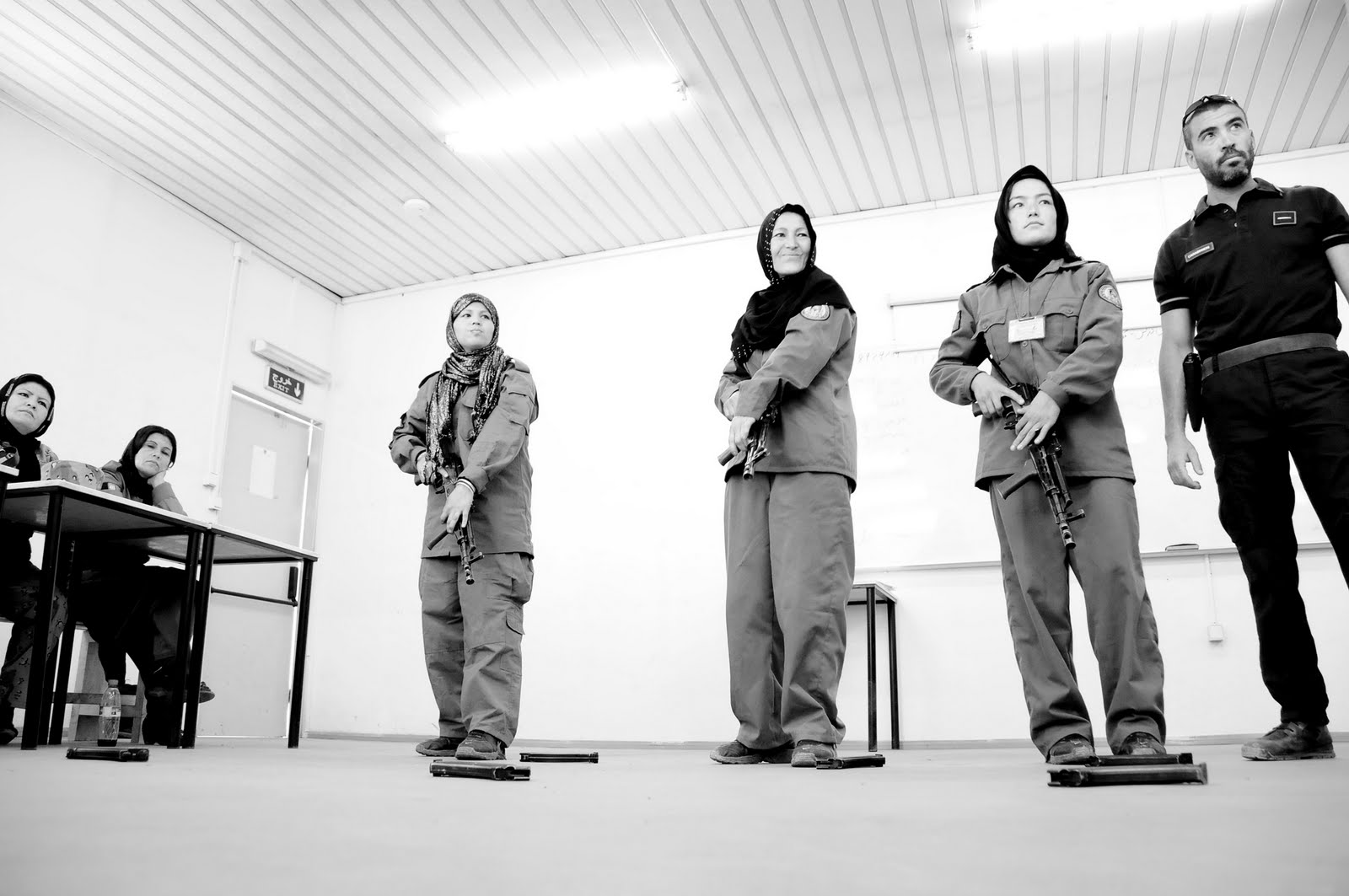
 As the people of Afghanistan work, with the help of the international community, to rebuild their government and military forces, the country is seeing traditional beliefs clash with progressive attitudes. More and more women are entering the work force, holding government positions and serving in their military. I recently had a chance to speak with several women who had graduated from the Afghan National Police Academy in Kabul.
 Petite and trim in her grey police uniform with a black scarf tucked neatly around her hair, 3rd Lt. Marzia Fazai recognized her country’s need for female police officers. In a religious culture that has strict rules about male and female interaction, women are needed to search females during police operations. Fazai enrolled in a six-month accelerated police officer’s course and has spent the past four years working in the Afghan Uniform Police and as an academy instructor.
With just under 1,000 women police in all of Afghanistan, Fazai is in the minority, but she hasn’t let that stop her from pushing through countless cultural boundaries. When she joined the academy, Fazai said that her fellow male students weren’t respectful and often gave her a hard time. Fazai’s family was supportive of her decision and when she wanted to drop out to attend a civilian university they encouraged her to keep pursuing her goals.
Now four years later Fazai said that despite initial interference with her work from male colleagues, she is able to teach both male and female students. She has also had her share of real-world police work; Fazai was part of an operation that rescued a female journalist who was kidnapped.
 Joining the Fazai among the ranks of policewomen in the field, 2nd Lt. Zar Mina, a recent graduate of the three-year officer’s course, works academy legal department. Like Fazai, Mina sees the societal necessity of having women in the police.
Initially her family was not in favor of her joining the academy; she said they heard rumors of an unsafe, bad environment for female trainees and people said bad things about women in the police. After her family visited the campus, they changed their mind and supported her decision. The only woman in her graduating class, Mina had to prove herself to her male students and teachers; she was first in her class for academics, marksmanship and physical fitness.
“The first semester was the hardest; the males were saying bad things and I had a lot of bad days, but I never thought about quitting,” she said. “The second semester was easier and the third even more; my classmates and I had competitions to see who the best was.”
 Overseeing the female training, living conditions and treatment at the academy is Col. Naiz Bibi, head of the Women’s Training Department. A 29-year police veteran, Bibi spends much of her time recruiting, often traveling to other provinces to speak with women and their families. Her support and recruiting work is more important than ever; President Karzai announced that an additional 5,000 women need to be added to the police force over the next five years. Although Bibi takes a bodyguard on her trips out, she told me she isn’t afraid of the danger; she has lived through the grip of the Taliban and has seen what she described as dark days. When I asked Bibi about life under the Taliban, she wouldn’t say much other than life was difficult and women didn’t dare leave their homes. Her husband was also a police officer, and he encouraged her to pursue her career – she said she loves being an officer and being in the military is part of a female’s duty, just like being a doctor, teacher or an engineer.
The fact that her husband was also in the police and one of her biggest supporters is something Bibi is quick to mention when speaking to young women and their families. With the police force having a reputation as a dangerous place for women to serve and rife with corruption, families are often reluctant to allow their daughters, wives, sisters or mothers to join. “My message for those females who don’t dare to come here is that they should revolt against their roles and join the police; we are here beside them to help them,” she said. “My great ambition is to make a lot of females like myself. I encourage females and their families to come and join because this job is a holy job in Islam.”
While their experiences, backgrounds and education levels differ; Fazai, Mina and Bibi are united in their goal to serve their country and the future women of Afghanistan. Fazai, who hopes to have a family of her own one day, said she will only marry someone who will not interfere with her chosen occupation. And Mina, who is just starting out in her career, said that she knows the women of Afghanistan still face many challenges, but there are signs of improvement.
Overall, Mina is right –things are slowly getting better for women here, but more are needed to stand up and push through boundaries. I think I heard the plight of Afghan women described best by Col. Shafiqa Quarashi, the Police Chief of Gender and Human Rights Division. Recognized by U.S. Secretary of State Hilary Clinton in March as one of 10 international women of courage, Shafiqa gave a speech to a group of police women where she made a powerful statement. “Who is saying women can’t do anything? We can do everything, anything you want,” she said. ““No one will give your rights to you as a gift, you have to take them.”
Thursday, July 22, 2010
In the palm of your hands
 Abandoned as a baby, 12-year-old Haidar has never buttoned a shirt, held a pencil, combed his hair or played with a toy. Born with a twisted knot of bone, joints and fingers instead of normal hands, Haidar never been able to properly care for himself; he has only been able to use his wrists and forearms to pick up objects and manipulate his environment.
Haidar was brought to the National Military Hospital in Kabul in the hopes that the Afghan army doctors there would be able to help his situation, but they lacked the expertise to operate. When they learned an American reconstructive hand surgeon would be soon arrive as part of the new medical embedded training team rotation, the ANA doctors admitted Haidar.
One month later, U.S. Navy Capt. Jerone Landstrom, a surgeon specializing in hand and microsurgery, arrived and Haidar had his left hand operated on, giving him, for the first time, the ability to pick up objects. While Haidar’s hand will never look like a normal hand, it is functional.
Our office heard about the operation, and thought that it would make a great story. We cover anything related to training, but so often that focus is limited to developing the Afghan National Security Forces, even though our mission scope is much broader. We were invited to come out to the hospital to meet with Dr. Landstrom and the Afghan doctors who assisted him during the operation.
Working with Dr. Ab Ghafoor-Ateef, the Afghan orthopedic resident who admitted Haidar, Dr. Landstrom, who has been practicing for 27 years, taught the surgical staff the essentials for performing complex reconstructions. This type of surgery hadn’t been performed at the 400-bed military hospital before; Dr. (Gen.) Bahaudin, head of the surgery department, told us that the hospital typically treats major trauma injuries resulting from improvised explosive device attacks or vehicle accidents.
For a hospital used to dealing with trauma patients, Haidar’s case is a success story for both the Afghan physicians and U.S. mentors, especially as they work together to improve the supply and logistics systems and handle the nursing shortage. Based on their current tash-kil, or manning document, they don’t have enough nurses to fully support the ICU ward which international standards suggest having one nurse per bed, and there aren’t enough nurses to provide long-term care. The staff often relies on a patient’s family member to help feed and bathe patients.
More than anything, having the U.S. embedded medical team has given the Afghan physicians a chance to improve their technical skill base and improve the quality of care they’re able to offer patients. In addition to working directly with Dr. (Gen.) Bahaudin, who is responsible for nine departments including neurosurgery, urology and ear, nose and throat, Dr. Landstrom mentors the ICU staff as well as the plastic and orthopedics departments.
The center of the Afghan National Army healthcare system, the NMH mainly treats soldiers and their families, and Afghan National Police patients with injuries too severe for their own hospital to treat. So when I asked how Haidar was able to receive treatment, they told me a relative brought him, but no one seemed to know who he was or what relation he was to the boy. I’m guessing the relation, if he even exists, is a very distant one, but that just further demonstrates the Afghan capacity for compassion.
In terms of sterility, cleanliness, efficiency and capability, NMH is definitely not a typical Western hospital, but they are doing the best they can with what they have. Dr. Landstrom told me that the staff has far exceeded his expectations; he has worked at hospitals in other developing countries like the Philippines and in comparison the NMH has much higher standards.
Landstrom told us that the staff has far exceeded his expectations and have higher standards than some of the hospitals he’s worked at in other developing countries like the Philippines. Landstrom’s goal is to pass along some of his expertise to the surgeons during his year-long tour; already they are learning and taking over – Dr. Ghafoor assisted in Haidar’s first surgery and will be the lead surgeon on the second operation. I hope Haidar’s second operation is as successful as the first; I couldn’t image how difficult his life must have up this point and a simple thing like being able to pick something up can change a life.
Wednesday, July 14, 2010
Afghanistan 2010, part duex
 A few days ago, our office said good-bye to the Air Force folks I came here with. They were packed up, ready to begin the long journey back to the states and home, back to reunions with family and friends. Many, me included, have been away from home since November. I thought I would feel sad or regretful as I watched them load up the trucks with their gear and said good-bye, but for some reason I didn’t. Instead of throwing my gear in with theirs and heading out, I was just ending another duty day here. I was asked to extend my deployment and eventually agreed, so instead of leaving this July, I’ll be here until January 2011.
 I know it may seem hard for people to understand; some people have called me crazy, some said stupid, but that’s their opinion. I guess for the most part, I just don’t feel ready to leave. Our commander says what we’re doing here is a sprint, not a marathon, and that if we at the end of our deployment feel we can’t work another day, then we were successful in our mission here.
 There have been times I’ve been so tired, I fell asleep sitting up, slept in airports, couches, floors, vehicles. There have been tumultuous times; I’ve been frustrated, upset, and so angry I wanted to scream or throw something. There were also times I was scared and exhilarated, and times when I swore I couldn’t wait until July came … but now that it’s here, I’m ready to do more. I can honestly say that despite all the negatives, I have also felt fulfilled. This is probably some of the most important work I’ve done in the military and I’m not quite ready to let go.
 Someone said we are changing the dynamics in Afghanistan; I challenge anyone who says that we are not making progress here to look around. Afghanistan is coming full-circle; 30 years ago women worked as doctors, teachers and lawyers. It was not the kind of atmosphere associated with western, developed countries, but they were developing into a modern country with modern attitudes and beliefs; that was brought to a screeching halt with the advent of the Russian invasion and continued with the internal fighting and rise of the Taliban. With war comes a focus on survival, not education or development and unfortunately, this breed’s ignorance. There are people who will prey on the uneducated, and use their lack of knowledge to support their ideals.
 Now, women are entering the workforce … again. They are going to school, women are supporting their families, becoming doctors, lawyers, serving in the government and even working in the fashion industry. The training and mentoring NATO Training Mission – Afghanistan offers goes much deeper than military and police forces; we are helping them create a national military and police healthcare system, literacy programs, working with their department of public works and various government agencies. We even have individuals partnered with non-government agencies to support micro-loan programs, promote women’s rights and help develop Afghanistan’s economy.
 What we are doing here, whether we succeed or fail, will forever be in our history, and I want to be a part of that history. I joined the Air Force for many reasons, but one of them was to make a contribution, to help people. I hope that through our words and images, we are making lives better for the people here and giving them a chance to really live, not just exist and survive. Yes, isn’t always fun; it’s hard work and I miss my friends, family and the little things (privacy, good food, sleeping in, days off, driving for fun with the music on and the windows down, wearing my hair down, long showers, I could go on and on really) BUT what is happening here is more important than that. Than me. So, I stayed. We’ll see what the next six months brings!

Monday, June 28, 2010
Fighting Taliban, recruiting challenges in Marjah
 The heat was intense and stunning; as we stepped of the helicopter, the rotors pushed waves of suffocating hot air toward us. Sweating under 40 pounds of body armor, I stumbled over the rocky ground escaping the noise, dust and heat and climbed into the dirty and hot vehicle waiting for us. Baking under the southern Afghanistan sun, Helmand province is flat, dry and dusty. It is also home to Marjah, a district recently in the news as the site of major military operations conducted by U.S. and Afghan forces in order to clear out Taliban insurgents.
On a recent visit to Marjah, my boss, Lt. Gen. William Caldwell IV, NATO Training Mission – Afghanistan commander, met with Afghan National Civil Order Police leadership to discuss challenges in the area.
 The training and development goals of NTM-A are multi-faceted, and although great strides have been made, there remain many hurdles to overcome. From recruiting to literacy development, building the Afghan National Security Forces is a complex challenge and nowhere are these challenges more apparent than in the Taliban strongholds of Kandahar and Helmand provinces.
 Working side-by-side with U.S. Marine police mentor teams, the ANCOP, an elite police force, are continuing to provide a majority of the security in the area despite large scale operations ending two months ago. The goal is to recruit and train enough Afghan Uniform Police so that the ANCOP units can be utilized elsewhere, or return home for a rest.
The problem, Regional Command – Southwest leaders told us, is with recruiting enough local police officers to take over permanently. Afghan Police, unlike their Army counterparts, are recruited locally, and once they complete basic training, serve in their home districts. Kandahar is the birthplace of the Taliban; with a strong insurgent presence lingering in there and in Helmand province, police recruitment is a difficult process at best.
 During a meeting with Afghan Maj. Gen. Sharif, ANCOP commander, the RC-SW commander, U.S. Marine Maj. Gen. Mills, told us his training center at Camp Leatherneck is ready to take on more ANP recruits. The Afghan manning document, or Tashkil, authorizes 311 police officers for Marjah, but there are only 90 currently serving; a class of 32 police officers started their eight-week basic training course June 21, however only eight of the new recruits were from Marjah.
“We keep hearing that there are young men out there who are interested in joining, and are on the fence. Many are concerned about their families and what would happen if they joined,” said Marine Lt. Col. Carlos Orellana, RC-SW C-10 director.
 Our visit took us to Combat Outpost Turbett, a small U.S. Marine post in Marjah where the Marine PMT’s live and work with ANCOP forces. From there, we walked through the village directly outside the post. Everywhere we went, we drew attention, and some friendly stares; a few villagers came up to shake hands with the Afghan and U.S. military leaders. On a stop in an unfinished building where Afghan police were taking shelter from the sun, little kids came up to us, curious as always. One little boy pointed at me and asked, “Is that a woman?” Sigh. I’m not sure if it was the armor I was wearing or just the fact that a woman walking around on the street with a group of men is a very rare sight. In fact, during our entire time down there, I didn’t see any women or even the little girls that I typically see out playing on the street.

While we were talking to the boys, me kicking myself for not bringing candy, the sudden burst of gunfire broke through our conversation. Everyone stopped, and in the silence one of the boys said what we were all thinking, “Taliban” with a scared look on his face. Turns out there was a gun fight taking place in the street near-by, so after the marines and Afghan police cleared our new route, we headed back to the combat outpost. Gunfire broke out again during our stop at the new government district headquarters; this time we were getting into our MRAP’s when the gunner in my vehicle shouted down “Contact to the south, we’re getting contact to the south.”
 I twisted in my seat to see Afghan police running to get into defensive positions and ducking as bullets hit the walls around them, sending up plumes of dust. Ordered to stay in the vehicle, I could only watch and try to get a few pictures through the dusty window; the gunner was told not to engage unless our vehicle took a direct hit. In those few minutes, I could fully understand the frustration many Marine and Army ground forces say they feel with the restrictions on enemy engagement.
Our visit only highlighted the challenges facing us as the U.S. and Coalition forces work with the Afghan government to create a safe and stable presence in the area. Unfortunately, it’s going to take a lot more time and effort from the Afghan government, military and civilian population, to completely remove the grip the Taliban has on the area. The civilians may be tired of fighting, but their fear of Taliban retaliation and their lack of education keep them repressed.
When it comes to securing their provinces, Afghan leaders, both civilian and police, recognize the challenges facing them and they seemed, more than anyone, to want to bring peace and stability to their people.

Sunday, June 20, 2010
Wedding crashers, Afghan style
 At the insistent tug on my hand, I suddenly found myself part of a clapping, cheering circle of dancing women, a player in a foreign wedding dance ritual. Immediately I became self-conscious – what if I wasn’t dancing right, or moving the right way? What was expected of me? As I looked around at the laughing, encouraging faces, I realized it didn’t matter what I did as long as I participated. I kicked off my shoes and enthusiastically danced along.
It wasn’t the wedding of anyone I knew and I was definitely in unfamiliar territory but all the same, it was a captivating experience.
Last night as I was eating dinner with a co-worker, I received a phone call from an Air Force captain who used to live and work in Afghanistan before she joined the military. Did I want to go to an Afghan wedding? Of course, I replied. Could I be ready in five minutes? Um, of course.
I dropped everything, ran to her room where she had laid out a few outfits that were appropriate for an Afghan wedding. I put on a pretty dark red flowing tunic top and loose pants and beaded pointed shoes and ran back to my office for my camera, all the while feeling completely conspicuous. In a small base where everyone wears either a military uniform or khaki pants with a polo shirt (the standard contractor uniform), an American woman in Afghan garb stands out.
The large wedding hall was filled to the brim with women and children running around. For the most part, hte men were in a separate room, with the younger boys and children mixed in with the women. The women were decked out in their finest, with the dresses ranging from garish to beautiful, some in bright gaudy colors and some decorated elaborately with hundreds of beads and intricate designs. Everything sparkled under the soft yellow lights – their sequins, jeweled hands, hair pieces and shimmery make-up.
Although the celebration had started an hour or so before we got there, in typical Afghan fashion, nothing ever starts on time, so we hadn’t missed much. After we arrived, the band got started and the dancing began. Other than the circle dance where a large group of women were dancing at once, the rest of the time just one or two dancers were out on the floor.
Shortly after the band started, the bride and groom, who had completed the formal part of the wedding ceremony the day before, showed up. They sat in a pair of chairs on a platform behind a table decorated with lots of flowers. One by one, guests came up to have their picture taken with them; although the guests smiled, I noticed the bride never did. I was told it wasn’t appropriate for her to look cheerful; even though the bride and groom knew each other and were both agreeable to the union, it would be an insult to the bride’s family for her to look happy.
Overall, the women were so welcoming and open with me. Some stared at me curiously, probably wondering who I was and what I was doing there, but all were friendly. They smiled, nodded and encouraged me to dance, tried to communicate and let me hold their oh-so adorable babies. And while I wasn’t able to take as many pictures as I wanted, the kids absolutely loved my camera, and kept coming around my table hoping I would snap a photo. They were a curious and open bunch; we wrote down each other’s names, drew birds, hearts and stars, and I taught them how to play tic-tac-toe. Several of the women spoke fluent English, including one young woman who had spent most of her life in Germany; she made the trip to Afghanistan for the wedding and was meeting most of her extended family for the first time.
Like American weddings, Afghan celebrations can go long into the night; when we left at 10, the food was just getting ready to be served; I’m sure it would have been an impressive spread. From what I learned about Afghan traditions, the dancing would have gone until well after midnight.
Despite all the unfamiliar rituals and language barriers, I had an amazing time. I know with my pale skin and red hair, I stood out, but these women, who had to know I was no relation the bride or groom, made me feel completely welcome. It was definitely a once in a lifetime experience, and something I’m thankful I got to participate in.
And I'm not 100 percent sure but I might have participated in some obscure Afghan wedding rite; a very insistent mother kept pushing me to talk to her son and she liked to play with my hair. When she gave me a baby to hold, I knew it was some sort of a test to see if I liked children. Unfortunately, I think I passed ... as I left, the son slipped me his phone number. So the next wedding I dance at just might be my own!
Subscribe to:
Posts (Atom)

